
The GOAT of Australian Economics
Applying Cowen’s GOAT to the history of Australian economic thought
Joseph Schumpeter once claimed he had three goals in life: to be the greatest economist in the world, the best horseman in Austria, and the greatest lover in Vienna. He is said to have succeeded in two.
We earlier discussed the possibility of modern contenders for the title of Economics GOAT. Here we look more locally: who is Australia’s greatest economist?
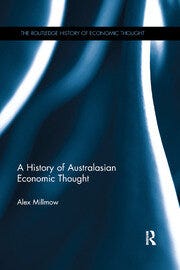
To answer this question, we can apply Tyler Cowen’s GOAT framework to the work of the great Australian economists, as summarised in Alex Millmow’s A History of Australasian Economic Thought.
Contenders for Australian Econ GOAT
Any list of great Australian economists is going to include the following: Lyndhurst Giblin, Colin Clark, Trevor Swan, and John Harsanyi. To this we might add Heinz Arndt, Max Corden and H.C. “Nugget” Coombs.
Lyndhurst Giblin was the intellectual leader of Australian economics in the interwar period.1 He co-founded the Economic Society of Australia and developed the 1931 Premiers’ Plan, which while later viewed as too contractionary, laid the foundation for Australia’s later adoption of Keynesianism in theory and practice.
Although born in England, Colin Clark lived and worked in Australia for decades. He was a pioneering economist-statistician, who made path-breaking contributions to national income estimates and worked closely with Keynes. Clark was also a contributor to development economics and the productivity structure of different industries. Later in his career he was deeply influential in Australian policy circles, particularly in Queensland.
Widely regarded as the greatest economic theorist Australia has produced, Trevor Swan was a pioneer of modern macroeconomic thought. He independently developed the Solow-Swan model, paving the way for how economists understand long-run growth. He also created the Swan Diagram for balancing internal and external economic stability. Swan’s work was highly original and influential globally, even if he didn’t share Solow’s Nobel in 1987.
While he spent only six years in Australia, John Harsanyi is strongly associated with Australia and the only Nobel winner on this list. Harsanyi made deep contributions to the analysis of games of incomplete information, now known as Bayesian games. Of this list, Harsanyi’s work is the most foundational for economic theory, complemented by his concern for real-world application like bargaining and political systems, but weakest on empirical research.
Heinz Arndt was Australia’s leading expert on Asian economic development. Arndt’s work spanned from Australia's domestic economic policy in the 1950s (he wrote a classic analysis of the Great Depression’s lessons) to a pivot in the mid-1960s in founding the Indonesia Project at ANU, at a time when few economists focused on Asian developing economies. Under his leadership the Indonesia project produced influential research that assisted Indonesia’ own economic policy reforms and opened up academic exchange.
In a similar vein to Arndt, Max Corden was one of the world’s great trade economists. Corden developed the theory of “effective protection”, a measure that reveals the true protective effect of tariffs on different industries. He also famously analysed the problem of “Dutch Disease”, the disruptive impact of commodity booms on other sectors, which has been directly relevant to Australia’s resource rich economy. His work combines original ideas, rigorous empirical analysis of protection costs, and is relevant to micro (tariff reform) and macro (currency appreciation) phenomena. He also served as a senior advisor to the IMF at crucial times.
Unlike everyone else on this list, “Nugget” Coombs exemplified the economist-statesman, rather than the academic. Coombs was Australia’s premier economic policy maker of the mid-20th century, who guided Australia’s post-war reconstruction; served as the first Governor of the Reserve Bank of Australia; and advised governments across the political spectrum. He was instrumental in drafting the 1945 White Paper on Full Employment and in shaping the mixed economy of the post-WWII era. Coombs also championed innovative ideas like using economic policy to support Indigenous Australia’s welfare and fully accounting for the environmental impact of economic growth.
The winner(s): So who is the greatest Australian economist?
Using Cowen’s criteria - they must be original; of great historical importance; serve as a creator and carrier of important ideas; have a hand in both theory and empirics; have a hand in both macro and micro; and be ‘not too wrong’ on the substance of issues - my conclusion is that there is a “top three” tier of candidates.
These are Trevor Swan, Colin Clark and for different reasons Nugget Coombs. Swan because he was Australia’s finest economic theorist and made major macro and micro contributions of global importance; Clark because he was a pioneer in transforming economic measurement and a key contributor to development economics, while also being a fine government advisor; and Coombs because his influence on economic policy across decades and topics is unparalleled in Australia and in its scale matched by very few globally. Coombs would be a very Australian pick. Of these, I suspect Cowen would vote for Swan as having the broadest, most original contributions, and swap Corden for Coombs in the top tier.
What should we make of this?
Note first that this list, while impressive, reflects Australia as being part of the Anglo-American economics tradition, rather than one of its own. Swan’s largest contribution was independently discovered by Solow, and Clark’s with Kuznets and others. Coombs’ record is impressive in the Australian context but less so globally.
The unique Australian contribution, if there is one, appears to be a focus on international macro and trade, particularly in the context of distance and south-east Asia. In Australian macroeconomics models are small open economies by default. GDP is C+I+G+NX from the get go, rather than NX added later as in American introductory courses. And there is often a deeper, earlier emphasis on the specifics of trade and development.
This is itself a reflection of the largely pragmatic rather than theoretical nature of Australian economics. As a relatively small, geographically isolated economy with a relatively small academic base, Australian economists have naturally been pulled into the most important, most applied and most unique to Australia policy questions. These are naturally trade, international finance and relations with south-east and east Asia.
And yet, doing that alone isn’t enough to be the Australian GOAT in my view. While Australia's economic thinkers often shine brightest when engaging pragmatically with local problems, the greatest among them have combined deep theoretical insight with practical policy influence, producing insights valuable beyond Australia's shores. A modern contender for Australian Econ GOAT would in turn also need to tackle pragmatic questions and create and carry ideas of grander scale.
Post-script: If one is willing to expand the search to New Zealand, the most household name on this list would be A.W. Phillips, of Phillips Curve fame. His recognition of an empirical relationship between unemployment and inflation continues to be central to economic theory and policy, albeit with significant amendment following the breakdown of the relationship in the stagflation of the 1970s. For that contribution alone he would be on the shortlist, albeit potentially not at number 1.
It is striking that there are no prominent Australian economists prior to the interwar period.